Table of Contents
Melasma is one of the most stubborn pigmentation conditions in skin medicine. It appears as symmetrical brown or grey-brown patches, usually across the cheeks, upper lip, and forehead. Hormonal shifts, sun exposure, and heat all trigger it, and it has a reputation for returning the moment you stop protecting the skin.
A Cosmelan peel for melasma is one of the most studied professional treatments available. It works by interrupting the enzyme cascade that produces excess melanin, fading existing patches and suppressing new ones over a structured six-month programme. Unlike a standard chemical peel, it targets multiple steps in the pigmentation pathway at once, which is why it consistently outperforms single-ingredient approaches.
This guide covers how the treatment works, what to expect day by day during the peeling stages, realistic before and after outcomes, costs in the UK, and how Cosmelan compares to other peel options.
Key Takeaways
- Cosmelan targets multiple steps in melanin production, making it highly effective against melasma
- The full programme lasts around six months: one in-clinic mask followed by a home maintenance phase
- Peeling and redness are expected in the first one to two weeks. This is not damage but the treatment working
- Sun protection every day is non-negotiable throughout the programme
- Most patients see visible fading within four to six weeks and significant clearing by week twelve
What Is a Cosmelan Peel for Melasma?
Cosmelan is a professional depigmentation treatment developed by the Spanish brand mesoestetic. It is not a standard acid peel. Instead, it combines a blend of active depigmenting agents, including kojic acid, phytic acid, azelaic acid, and arbutin, that collectively suppress the production of melanin at multiple points in the biochemical pathway.
The treatment is specifically designed for melasma, post-inflammatory hyperpigmentation, and hormonal pigmentation. It is delivered in two stages: an in-clinic application of a concentrated depigmenting mask, followed by a home maintenance programme using the Cosmelan 2 cream for up to six months.
Because it addresses the root cause of pigmentation rather than simply bleaching the surface, results tend to be more lasting than those from a single-ingredient approach, provided the maintenance protocol and daily SPF are followed consistently.
How Does a Cosmelan Peel Work on Melasma?
Melanin, the pigment responsible for skin colour, is produced by specialised cells called melanocytes. In melasma, these cells are overactive, producing excess melanin in response to hormones, UV light, and heat. Cosmelan works by blocking tyrosinase, the key enzyme that drives melanin synthesis, while simultaneously accelerating cell turnover to remove already-pigmented surface cells.
The treatment mechanism works on several levels simultaneously:
- Tyrosinase inhibition: Kojic acid and azelaic acid block the enzyme responsible for melanin production at source.
- Melanin transfer disruption: Arbutin and phytic acid interfere with how pigment is transferred from melanocytes to surrounding skin cells.
- Accelerated cell turnover: The exfoliating components bring pigmented cells to the surface and shed them faster than the skin would naturally.
- Anti-inflammatory action: Azelaic acid also calms the inflammation that triggers post-inflammatory hyperpigmentation in darker skin tones.
This multi-pathway approach is why Cosmelan is particularly effective against melasma, which is notoriously difficult to treat with single-ingredient products alone.
Who Is a Suitable Candidate?
Cosmelan is suitable for a wide range of skin tones and types, which is one of its advantages over laser treatments that carry a higher risk of post-inflammatory hyperpigmentation in melanin-rich skin.
You are likely a good candidate if you:
- Have diagnosed melasma or persistent hormonal pigmentation
- Have tried topical creams without satisfactory results
- Are not pregnant or breastfeeding
- Are willing to commit to the full maintenance programme
- Can wear SPF 50+ daily throughout the treatment period
- Have Fitzpatrick skin types I through VI (with appropriate adjustment of the protocol)
Cosmelan may not be suitable if you:
- Are pregnant or breastfeeding
- Have active eczema, rosacea, or open skin lesions in the treatment area
- Are using isotretinoin (or have done so in the last six months)
- Have a known allergy to any component of the formula
- Are unable to avoid sun exposure during the programme
Tired of Melasma That Will Not Fade?
Melasma responds best to a structured, medically led programme. At The Skin Firm in Sheffield, Dr Naren assesses your pigmentation pattern and skin type before recommending Cosmelan, ensuring the protocol is calibrated for your complexion.
- In-depth pigmentation consultation with Dr Naren
- Cosmelan mask applied in clinic under controlled conditions
- Customised home maintenance kit and aftercare plan
Cosmelan Peeling Stages Day by Day
Knowing what to expect at each stage helps you manage the process calmly rather than panicking at normal skin reactions. The timeline below reflects a typical response. Individual variation is common.
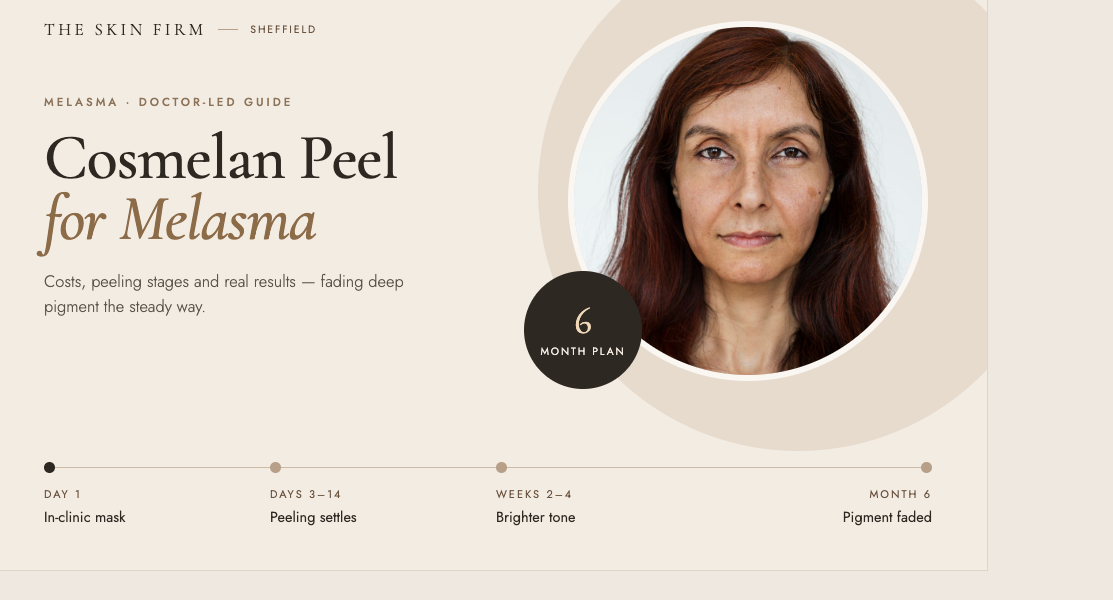
The Cosmelan 1 mask is applied in the clinic and left on for eight to twelve hours, depending on your skin type and sensitivity. You return home with the mask on and remove it at the prescribed time. The skin will feel tight and look slightly pink.
Redness and warmth increase. The skin may look sun-burned and feel dry. This is the beginning of the active depigmentation response: the formula is working.
Peeling begins, typically starting around the nose, mouth, and chin. The skin lifts and sheds in patches. Do not pick or peel manually, as this risks scarring and post-inflammatory pigmentation.
Peeling intensifies across the cheeks and forehead. The skin underneath looks brighter and more even-toned. You begin applying the Cosmelan 2 maintenance cream.
Most of the visible peeling subsides. The skin surface looks fresher and patchy pigmentation may already appear lighter. Dryness and mild sensitivity remain.
Skin stabilises. Residual redness fades and the new skin surface feels smoother. SPF application is more important than ever at this stage, as the new skin is particularly vulnerable to UV.
Cosmelan Peel Aftercare
Your aftercare compliance directly affects how well the treatment works and how quickly your skin settles. The following are non-negotiable during the programme:
- Apply SPF 50+ every morning, even when indoors near windows, as UV exposure will undo results
- Use the Cosmelan 2 cream as directed, typically twice daily for the first month, then once daily
- Moisturise with a fragrance-free, non-comedogenic cream to manage dryness and sensitivity
- Avoid retinoids, AHAs, BHAs, and other active skincare products during the first four weeks
- Do not use hot water on your face. Lukewarm only
- Avoid saunas, steam rooms, and vigorous exercise for the first week
- Do not undergo laser treatments, IPL, or chemical peels while on the programme
- Wear a wide-brimmed hat if you must be outdoors for extended periods
Cosmelan Peel Side Effects
Most side effects are predictable and time-limited. Knowing what is normal prevents unnecessary concern during the peeling phase.
Expected and normal:
- Redness and warmth in the first three to five days
- Visible peeling and flaking, typically between days four and ten
- Dryness and skin tightness throughout the first two weeks
- Temporary darkening of pigmented patches before they fade. This is the pigment rising to the surface
- Mild sensitivity and tingling when applying the maintenance cream
Contact the clinic if you experience:
- Severe swelling, blistering, or oozing
- Intense itching that does not settle with a fragrance-free moisturiser
- New areas of dark pigmentation that were not present before treatment
- Signs of infection: increased heat, crusting, or pus
Worried You Might Pick the Wrong Treatment?
Not every pigmentation issue responds to Cosmelan, and not every Cosmelan protocol suits every skin type. Speak directly with Dr Naren to confirm whether this is the right approach for your specific melasma pattern.
Cosmelan Before and After Melasma
Clinical before and after photography consistently shows significant fading of melasma patches after a full Cosmelan programme. Most patients see visible improvement within four to six weeks of the in-clinic treatment and a more dramatic change by week twelve as the maintenance phase takes effect.
When evaluating before and after images, look for:
- Photographs taken under consistent lighting, as natural light reveals the true depth of pigmentation change
- Images from a full programme (twelve weeks minimum), not just the initial peeling phase
- Before and after shots of the same skin tone, as results vary significantly across Fitzpatrick types
- Disclosures about maintenance products used, as results are not maintained without ongoing SPF and depigmenting cream
It is worth noting that Cosmelan significantly reduces melasma rather than eradicating it permanently. Melasma has no cure, but with proper maintenance and consistent sun protection, results can be sustained for one to two years.
Cosmelan vs Chemical Peel for Melasma
Both Cosmelan and chemical peels address pigmentation, but they work differently and suit different presentations.
Cosmelan is better when:
- Melasma is hormonally driven
- Pigmentation is deep (dermal melasma)
- Skin tone is medium to dark (Fitzpatrick IV–VI)
- Previous treatments have not held results
- A longer-term suppression protocol is needed
A chemical peel may suit when:
- Pigmentation is superficial (epidermal only)
- Post-inflammatory marks rather than melasma
- Lighter skin tones (Fitzpatrick I–III)
- Shorter downtime is preferred
- The goal also includes texture improvement
If your melasma sits near the surface, a lighter chemical peel may be the better place to start. In practice, many patients benefit from a combination approach: Cosmelan to address the underlying pigmentation drive, followed by periodic superficial peels to maintain skin clarity. A clinical consultation will determine which pathway is most appropriate for your skin.
How Long Does Cosmelan Last on Melasma?
Cosmelan does not permanently cure melasma. No treatment does. The underlying tendency to overproduce melanin remains. What Cosmelan achieves is a significant, prolonged suppression of that overproduction, which keeps skin even for one to two years in most patients who maintain their home protocol.
To maximise the duration of results:
- Apply SPF 50+ every morning without exception, as sun exposure is the single biggest trigger for melasma recurrence
- Continue using the Cosmelan 2 maintenance cream as directed beyond the initial six-month programme
- Avoid hormonal triggers where possible. Discuss contraceptive options with your GP if relevant
- Consider an annual top-up treatment or a maintenance peel to sustain results
- Manage heat exposure, as prolonged heat (saunas, hot yoga) stimulates melanocytes independently of UV
Cosmelan Peel Cost UK
Cosmelan is typically priced as a complete programme rather than a single session, reflecting the fact that the maintenance phase is integral to the outcome. Prices vary between clinics and are influenced by practitioner experience, location, and what is included in the package.
A thorough consultation is essential before committing to the programme. This ensures the treatment is appropriate for your skin type, confirms you are not contraindicated, and allows the practitioner to calibrate the protocol for your complexion and pigmentation depth.
Conclusion
A Cosmelan peel for melasma offers one of the most effective non-laser approaches to this notoriously difficult condition. By targeting multiple steps in melanin production simultaneously and maintaining suppression through a structured home programme, it achieves a depth of clearance that over-the-counter products simply cannot match.
The treatment requires commitment: consistent SPF, a disciplined maintenance protocol, and patience through the peeling phase. For patients who follow the programme properly, results typically last one to two years and can be extended further with periodic maintenance.
If you want a straight answer about what will help, book a chat with the team at The Skin Firm in Sheffield, led by Dr Naren. They can sort out a plan that truly fits your skin.
Frequently Asked Questions
How many Cosmelan sessions do you need for melasma?
Most patients need one in-clinic Cosmelan mask application followed by a six-month home maintenance programme. Severe or deep melasma may benefit from a second application after six months, but this is assessed on an individual basis.
Is Cosmelan painful?
The mask creates a warm, tingling sensation that intensifies over the hours it is left on. The peeling phase can feel tight and uncomfortable, but it is not typically painful. Most patients find it manageable with a gentle fragrance-free moisturiser.
Can Cosmelan make melasma worse?
In the first few days, pigmented patches may appear to darken temporarily. This is the pigment being brought to the surface before it sheds. It is a normal part of the process, not a worsening. If new pigmentation appears after the peeling phase, contact your practitioner.
How long does Cosmelan downtime last?
Visible peeling and redness typically last seven to fourteen days. Most patients take one to two weeks off from social commitments for the initial phase. After that, the skin settles considerably, though mild dryness and sensitivity may continue for another two to four weeks.
Can Cosmelan be used on all skin tones?
Yes. Cosmelan is formulated to be safe across Fitzpatrick skin types I through VI. Darker skin tones may require a modified protocol, specifically a shorter mask application time, to minimise the risk of post-inflammatory hyperpigmentation. A thorough skin assessment before treatment is essential.
Does Cosmelan work for melasma that has not responded to creams?
Yes, this is one of the most common reasons patients seek Cosmelan. Over-the-counter depigmenting creams typically address only one step in the melanin pathway, which is rarely sufficient for established melasma. Cosmelan targets multiple pathways simultaneously, making it significantly more effective for resistant cases.

Medically Reviewed By
Dr Naren Senthil NathanFounder & Clinical Director (MBBS, PGCertMedEd, MRCGP, FRCGP)